Clash Free: What It Means and How to Avoid Conflicts
Learn what clash free means, where the term is used, and practical ways to prevent scheduling, design, and software conflicts.
“Clash free” means that two or more things can coexist or work together without interfering with each other. The phrase is used in several fields, including construction, event planning, scheduling, and technology. To make a situation clash free, identify what could conflict, check how the parts interact, and address problems before they cause disruption. The right method depends on what is being coordinated.

Common types of clashes and what they disrupt
| Context | What conflicts | Typical impact | Useful check |
|---|---|---|---|
| Construction design | Building components overlap | Rework or installation delays | Model coordination |
| Event scheduling | Events share a time or venue | Double bookings | Calendar review |
| Software integration | Systems or dependencies conflict | Errors or failed updates | Compatibility testing |
| Network planning | Devices or channels interfere | Weak or interrupted service | Coverage and channel checks |
| Team workflows | Tasks or responsibilities overlap | Confusion or duplicated work | Ownership review |
| Product design | Parts or features interfere | Poor fit or usability | Prototype testing |
Compiled November 2026; check the provider's site for current details.
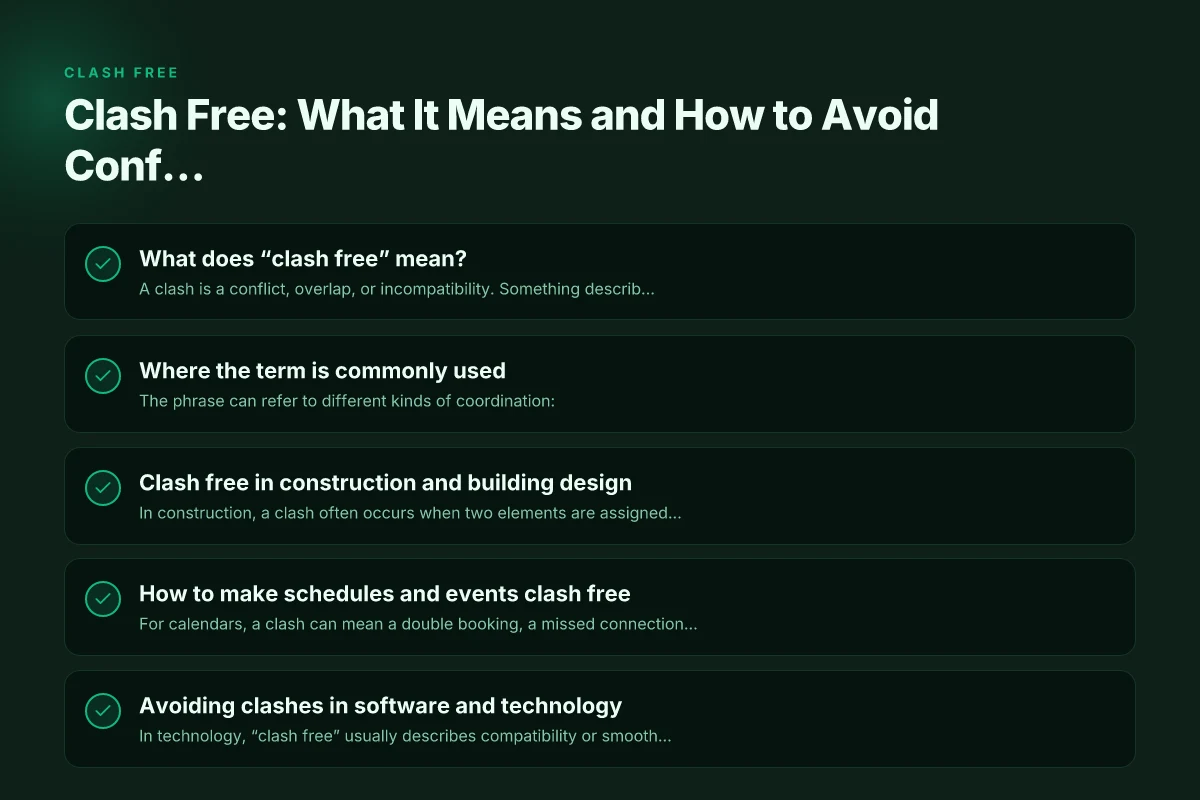
What does “Clash free” mean?
A clash is a conflict, overlap, or incompatibility. Something described as clash free has no relevant conflict with another item, activity, requirement, or system. It does not necessarily mean that absolutely nothing could go wrong. It means that the important clashes have been identified and avoided or resolved.
For example, two meetings are clash free when they do not take place at the same time for the same attendee. In a building design, services are clash free when pipes, ducts, cables, and structural elements can fit together without occupying the same space improperly.
The term is often used informally. In professional settings, it helps to say what has been checked and against which requirements. “Clash free” is more useful when it means, for example, “the coordinated model has no unresolved critical spatial conflicts,” rather than simply “the design is ready.”
Where the term is commonly used
The phrase can refer to different kinds of coordination: FortiGate IPsec VPN: Setup, Configuration, and Troubleshooting
- Construction and architecture: Building components are checked for physical overlap or access problems.
- Calendars and event planning: Meetings, appointments, venues, or activities are arranged without conflicting times or commitments.
- Software and technology: Components, updates, files, or system requirements are compatible and do not interfere.
- Products and design: Parts, materials, or features work together as intended.
- Travel and logistics: Connections, schedules, or delivery plans do not overlap in a way that makes the plan impractical.
The meaning changes with the context, but the basic idea stays the same: check how the parts interact, not just whether each part works on its own.
Ways to prevent clashes by context
| Context | Prevention method | Best time to check | Main benefit |
|---|---|---|---|
| Construction | Coordinate shared models | Before construction | Fewer site changes |
| Events | Check calendars and venue availability | Before confirming dates | Fewer double bookings |
| Software | Test dependencies and integrations | Before release | Fewer compatibility issues |
| Networks | Review device placement and channels | During planning | More reliable connections |
| Team workflows | Assign owners and deadlines | At task setup | Clearer responsibilities |
| Product design | Review prototypes and interfaces | Before production | Better fit and function |
Compiled November 2026; check the provider's site for current details.
Clash free in construction and building design
In construction, a clash often occurs when two elements are assigned the same physical space or when one element prevents another from being installed, accessed, or maintained. A pipe may pass through a beam, for instance, or a ceiling duct may leave too little room for lighting and other services. VPN FortiGate: What It Is, How It Works, and When to Use It
Teams often use building information modeling (BIM) software to compare digital models from different disciplines. A clash detection process can flag potential issues before construction, when resolving them is generally easier than making changes on site.
Common types of construction clashes
- Hard clash: Two modeled objects physically overlap, such as a pipe intersecting a structural column.
- Clearance clash: An object does not directly overlap another, but there is insufficient space for installation, operation, or maintenance.
- Workflow or coordination clash: The design may be physically possible but creates a sequencing, access, or responsibility problem.
A software report is a starting point, not a final decision. Some flagged overlaps may be intentional, while some important access problems may not be captured by a simple geometric check. Designers and contractors need to review the results, agree on priorities, assign responsibility, and document decisions.
How to make schedules and events Clash free
For calendars, a clash can mean a double booking, a missed connection, or a commitment scheduled when a key person is unavailable. The more people, locations, and dependencies involved, the more useful it is to coordinate from a shared source of information.
A practical process is: Com.NordVPN.Android: What the NordVPN Android App Does and How to Use It
- Collect the constraints. Note dates, time zones, participant availability, travel time, venue access, and deadlines.
- Use one reliable calendar or schedule. Keep changes in a shared system rather than relying on scattered messages.
- Check dependencies. A meeting may not overlap another, but it may still leave too little time to travel or prepare.
- Confirm key details. Verify the time, location, participants, and version of the plan with the people involved.
- Review after changes. Moving one appointment can create a new conflict elsewhere.
| Situation | Likely clash | Useful prevention method |
|---|---|---|
| Team meetings | The same attendee is booked twice | Compare shared calendars before confirming |
| Events | Two activities need the same room | Maintain a venue schedule and allow setup time |
| Travel | A connection is too short or overlaps another commitment | Include transfer and delay buffers |
| Project deadlines | Tasks depend on unavailable people or resources | Map dependencies and review capacity |
A schedule can be technically free of overlapping time slots yet still be impractical. Include preparation, travel, recovery, and setup time when those affect whether a plan can actually be followed.
A simple process for choosing a clash check
| Step | Action | Question to ask | Useful outcome |
|---|---|---|---|
| 1 | Define the items involved | What could overlap or conflict? | Clear scope |
| 2 | Identify shared constraints | Do items share space, time, or resources? | Key conflict points |
| 3 | Choose a review method | Would a calendar, model, or test help? | Suitable check |
| 4 | Compare plans or systems | Is there an overlap or incompatibility? | Conflicts identified |
| 5 | Resolve the issue | Can timing, design, or ownership change? | Agreed adjustment |
| 6 | Recheck the update | Did the change create another conflict? | Verified resolution |
| 7 | Record the decision | Who will act, and what happens next? | Clear follow-up |
Compiled November 2026; check the provider's site for current details.
Avoiding clashes in software and technology
In technology, “clash free” usually describes compatibility or smooth interaction. Two applications may compete for the same resource, a software update may conflict with an existing configuration, or multiple users may edit the same file and overwrite changes. Certificate Validation Failure Cisco VPN: Causes and Fixes
Before changing a system, check its requirements, versions, integrations, and dependencies. Test updates in a safe environment when possible, keep backups, and document what changed. For shared files or code, use version control or clear editing procedures so that separate contributions can be reviewed and combined.
No compatibility check guarantees that a system will never fail. Testing should cover realistic use cases, and teams should have a way to report and resolve issues. If a tool claims to be clash free, look for details about what it was tested against and what limitations apply.
A simple process for preventing clashes
Across different fields, the same steps help:
- Define the scope: Decide which people, objects, systems, times, or requirements need to be coordinated.
- Use accurate information: Outdated drawings, calendars, or specifications can hide conflicts.
- Check early: Finding a clash before a booking, installation, or release usually leaves more options.
- Prioritize by impact: A minor inconvenience and a safety-critical conflict should not receive equal attention.
- Assign an owner: Make clear who will investigate and resolve each issue.
- Record the decision: Keep a note of what changed and why, so the same problem does not return.
- Recheck after revisions: A fix in one place can create a new conflict somewhere else.
Recommendation
Treat “clash free” as a result to verify, not a guarantee based on appearance or a single automated check. Define what counts as a clash in your situation, use current information, and review the highest-impact conflicts with the people responsible. For a calendar, confirm availability and travel buffers. For a design, combine model checks with professional review. For software, test compatibility and keep a recovery plan. FortiClientVPNOnlineInstaller: How to Download and Install FortiClient VPN