Certificate Validation Failure Cisco VPN: Causes and Fixes
Troubleshoot Cisco VPN certificate validation failures by checking certificates, system time, trust settings, and VPN configuration.
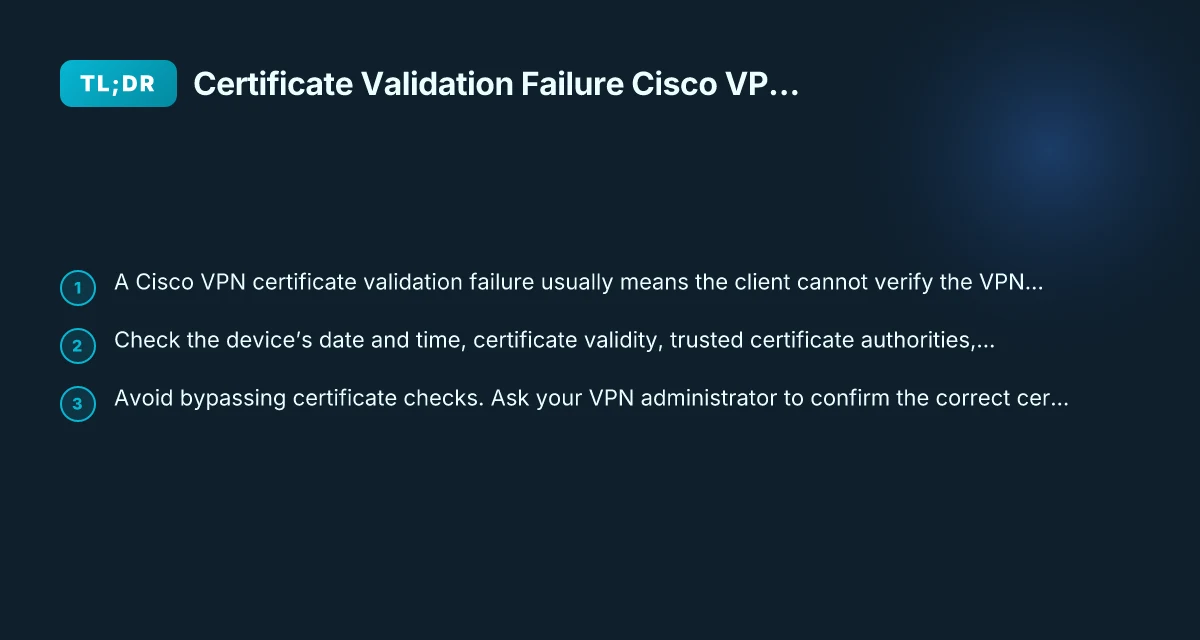
A certificate validation failure in Cisco VPN means the VPN client could not verify that the server’s certificate is valid and trusted. The most common causes are an incorrect device clock, an expired or mismatched certificate, a missing trusted certificate authority (CA), or a VPN profile that points to the wrong server. Start by checking the date and time, then confirm the server name and certificate chain with your IT administrator.
The exact steps depend on whether you use Cisco Secure Client (formerly AnyConnect), another Cisco VPN client, or a managed device. The message alone does not identify the cause, so avoid deleting certificates or disabling validation before your administrator confirms what is expected.
| VPN | Obfuscation | From / month | Plan | Free plan | Refund | Alipay | UnionPay | Crypto | Website opens in China | Trustpilot | |
|---|---|---|---|---|---|---|---|---|---|---|---|
 ZoogVPN | Turn on manually Shadow | $2.49/mo | 27 months: $59.99 | Yes | 7 days | ✓ | ✓ | ✓ | ✓ | Official site blocked; our special link opens (4.4 s) | 4.2/5 (195 reviews) |
 NordVPN | Turn on manually Obfuscated Servers / NordWhisper | $3.49/mo | 27 months: $94.23 | No | 30 days | ? | ✗ | ✓ | ✓ | ✗ Blocked | 4.2/5 (51,628 reviews) |
 ExpressVPN | ✓ On by default all servers | $3.00/mo | 28 months: $84 | No | 30 days | ✗ | ✗ | ✓ | ✗ | ✗ Blocked | 4.4/5 (29,706 reviews) |
 Surfshark | ✓ On by default Camouflage, with OpenVPN | See site | See site | No | 30 days | ✗ | ✗ | ✗ | ✓ | ✗ Blocked | 4.3/5 (31,823 reviews) |
 Proton VPN | Turn on manually Stealth, free plan too | $2.99/mo | 12 months: $35.88 | Yes | 30 days | ✗ | ✗ | ✗ | ✓ | ✗ Blocked | 2.1/5 (1,040 reviews) |
 Astrill VPN | Turn on manually StealthVPN / OpenWeb | $12.50/mo | 24 months: $300 | No | See site | ✗ | ✗ | ✗ | ✓ | ✗ Blocked | 1.3/5 (110 reviews) |
 Private Internet Access | Turn on manually Shadowsocks, OpenVPN only | $2.03/mo | 40 months: $81.2 | No | 30 days | ✗ | ✗ | ✗ | ✗ | ✗ Blocked | 4.2/5 (11,033 reviews) |
 CyberGhost | Turn on manually selected servers | $2.19/mo | 28 months: $61.32 | No | 45 days | ✗ | ✗ | ✗ | ✓ | ✗ Blocked | 4.0/5 (24,178 reviews) |
 PureVPN | Turn on manually switch to OpenVPN | $1.69/mo | 60 months: $101.55 | No | 31 days | ? | ? | ✗ | ✓ | ✗ Blocked | 4.4/5 (17,994 reviews) |
 AdGuard VPN | ✓ On by default TrustTunnel | $2.99/mo | 24 months: $71.76 | Yes | 30 days | ✓ | ✗ | ✓ | ✓ | Official site blocked; our special link opens (3.7 s) | 4.3/5 (290 reviews) |
 Mullvad | Turn on manually QUIC / Shadowsocks / LWO | $5.61/mo | €5/mo | No | 14 days | ✗ | ✗ | ✗ | ✓ | ✗ Blocked | 3.2/5 (192 reviews) |
 Windscribe | Turn on manually Stealth / WStunnel | $5.75/mo | 12 months: $69 | Yes | See site | ✗ | ✗ | ✗ | ✓ | ✗ Blocked | 4.7/5 (13,355 reviews) |
 StrongVPN | Turn on manually Scramble, OpenVPN TCP | See site | See site | No | 30 days | ✓ | ✗ | ✗ | ✗ | ✗ Blocked | 4.4/5 (2,695 reviews) |
 LightXtreme 闪连 | Not listed | $7.08/mo | 12 months: $84.99 | Yes | 30 days | ✓ | ✓ | ✓ | ✓ | ✓ Yes (3.5 s) | No page |
Prices checked 2026-11-10 on each vendor's pricing page (cheapest long plan, USD). Check the vendor's checkout for the final price.
Obfuscation checked 2026-11-14 on each vendor's site and help center: "on by default" = nothing to set; "turn on manually" = switch protocol or mode in settings; "not listed" = the vendor describes no obfuscation.
Payment methods checked 2026-11-10 on each vendor's payment pages: all 14 take cards and PayPal; ✗ = not listed, ? = the vendor's own pages disagree.
China access: whether the official website opens from mainland China networks (tests the website only, not the VPN connection). Last checked 2026-11-18 01:02 Beijing time.
Trustpilot score and review count checked 2026-11-10.

Editor's pick: NordVPN — fast, secure VPN — Strong encryption, a no-logs policy and apps for every device. 30-day money-back guarantee. Get NordVPN →
Compare common Cisco VPN certificate validation causes
| Cause | What to check | Likely sign | First action |
|---|---|---|---|
| Expired certificate | Validity dates | Expired or not yet valid | Renew or replace the certificate |
| Untrusted issuer | Certificate chain | Issuer is not trusted | Install or verify the issuing CA |
| Missing intermediate | Chain completeness | Intermediate CA absent | Add the intermediate certificate |
| Hostname mismatch | Certificate name and VPN address | Names do not match | Use the matching VPN address or certificate |
| Incorrect device time | Date, time, and time zone | Clock differs from current time | Correct the device clock |
| Revoked certificate | Revocation status | Certificate is reported revoked | Replace it and check its status |
| Incorrect certificate selected | VPN profile settings | Profile presents another certificate | Select the intended certificate |
| Stale VPN profile | Profile and certificate settings | Profile does not match current setup | Update or recreate the profile |
Compiled November 2026; check the provider's site for current details.
What the error means
When a VPN client connects, it checks the server’s digital certificate. This helps confirm that the connection is going to the intended organization’s VPN server, rather than an untrusted or impersonating server.
Validation can fail if the certificate is expired, not yet valid, issued by an authority the device does not trust, or issued for a different server name. The client may also be missing an intermediate certificate needed to link the server certificate to a trusted root CA.
Some Cisco VPN setups also use certificates installed on the user’s device to authenticate the user. In those environments, a failure may involve the client certificate, not just the server certificate. Your administrator can determine which certificate the error refers to.
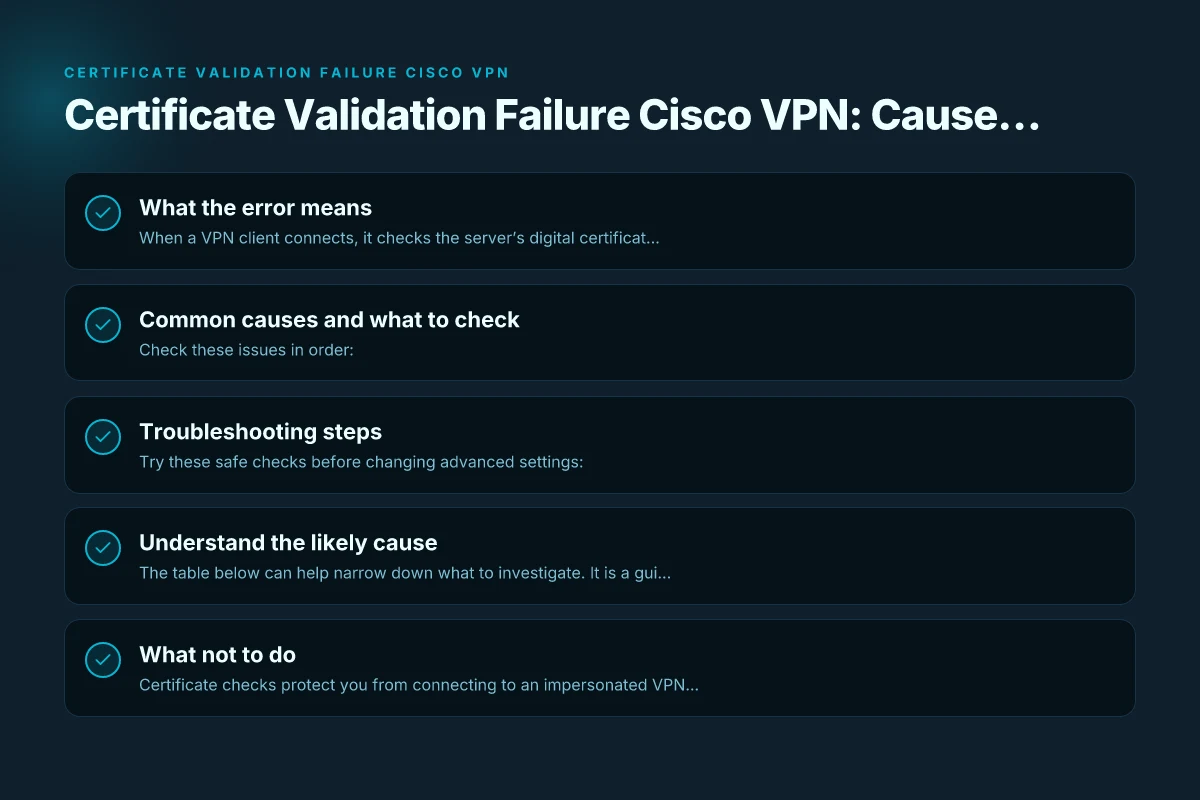
Common causes and what to check
Check these issues in order: FortiClientVPNOnlineInstaller: How to Download and Install FortiClient VPN
- Incorrect system date or time: A device clock that is significantly ahead or behind can make a valid certificate appear expired or not yet valid. Enable automatic time and time-zone settings, then reconnect.
- Expired or replaced server certificate: The VPN server’s certificate may have expired, or administrators may have renewed it without installing the full certificate chain.
- Server-name mismatch: The VPN address in your profile must match a name included in the certificate. A saved connection using an old hostname or an IP address may trigger a mismatch.
- Untrusted or incomplete CA chain: The device may not trust the CA that issued the certificate, or the server may not be providing an intermediate certificate.
- Out-of-date client or device software: Older VPN clients and operating systems can lack updated trust information or may not support the organization’s current configuration.
- Incorrect client certificate: If your organization uses certificate-based user authentication, the certificate may be missing, expired, installed in the wrong store, or not associated with the VPN profile.
- Changed VPN profile or gateway: A stale profile can point to a retired gateway or use settings that no longer match the organization’s certificate configuration.
Choose a troubleshooting step based on the result
| Step | What to inspect | If the check fails | If the check passes |
|---|---|---|---|
| Check device date and time | Date, time, and time zone | Correct them and retry | Continue to certificate checks |
| Inspect certificate validity | Start and expiry dates | Renew or replace the certificate | Check the certificate chain |
| Verify certificate chain | Issuer and intermediate certificates | Install missing trusted certificates | Check the VPN address |
| Compare names | Certificate name and VPN address | Use a matching address or certificate | Check certificate status |
| Check revocation status | Whether the certificate is revoked | Replace the revoked certificate | Review profile settings |
| Review VPN profile | Selected certificate and connection settings | Correct or refresh the profile | Check device or server configuration |
| Retry the connection | Whether validation succeeds | Record the error and escalate | Confirm the connection works |
Compiled November 2026; check the provider's site for current details.
Troubleshooting steps
Try these safe checks before changing advanced settings:
- Confirm the time and date. Set the date, time, and time zone automatically, then restart the VPN client.
- Verify the VPN address. Use the official server address or connection profile supplied by your organization. Do not substitute a guessed hostname or IP address.
- Update the client and operating system. Use your organization’s approved software source. On a managed device, check with IT before installing updates or reinstalling the client.
- Restart and retry the connection. If the error began after a network change, reconnect to a trusted network and try again.
- Capture the exact message. Note the full error text, the time it occurred, your operating system, the Cisco client version, and whether the issue affects other users.
- Contact your VPN administrator. Ask them to verify the server certificate’s validity dates, subject name, certificate chain, and the VPN profile’s server address. If client certificates are used, ask them to check your assigned certificate and enrollment status.
Do not install a certificate sent through an unverified email or website. If IT provides a certificate or profile, confirm that it comes from an official organization channel and follow the organization’s installation instructions. Free VPN Extension for Microsoft Edge: What to Choose and How to Use It
Understand the likely cause
The table below can help narrow down what to investigate. It is a guide, not a definitive diagnosis. The exact wording and logs matter.
| What you notice | Possible cause | Best next step |
|---|---|---|
| The error appears on one device only | Local clock, trust store, client version, or device certificate issue | Check time and updates; ask IT to review the device |
| Several users see the same error | Server certificate, certificate chain, or gateway configuration issue | Report the shared failure to the VPN administrator |
| The problem began after a profile or server change | Stale profile or server-name mismatch | Obtain the current official profile or server address |
| The error mentions expiration or validity dates | Incorrect clock or expired/not-yet-valid certificate | Check device time; have IT verify certificate dates |
| The error mentions an untrusted issuer | Missing CA or incomplete certificate chain | Ask IT to confirm the approved CA and server chain |
| The message refers to a user or client certificate | Missing, expired, or incorrectly enrolled client certificate | Contact IT or the certificate enrollment team |
What not to do
Certificate checks protect you from connecting to an impersonated VPN server. Do not select an option to trust an unknown certificate permanently, disable certificate validation, or install an unverified root certificate just to make the connection work. These steps can expose your login details and network traffic to interception.
Also avoid deleting certificates from system stores unless your IT team specifically instructs you to do so. Removing a required root, intermediate, or client certificate can create new problems and may affect other work services.
If the client offers certificate details, you can record the issuer, subject, and expiration date for your administrator. Do not treat a familiar organization name in the certificate as proof that it is safe. The full chain and server-name match need to be verified. NordVPN in China: What to Know Before You Travel
Decide what to do—and what to avoid
| Option | Appropriate when | Benefit | Risk or limitation | Recommendation |
|---|---|---|---|---|
| Correct device time | The clock or time zone is wrong | Addresses date-related validation errors | Does not fix certificate defects | Try early |
| Install a trusted CA certificate | The issuing CA is missing | Restores trust when the CA is verified | An untrusted CA should not be added | Verify the source first |
| Renew or replace a certificate | It is expired, revoked, or incorrect | Restores a valid certificate | Requires an authorized replacement | Use the approved process |
| Correct the VPN address | The address does not match the certificate | Aligns the connection name with the certificate | May require the correct service address | Confirm the address |
| Update the VPN profile | Its settings or certificate selection are stale | Aligns the profile with current configuration | Incorrect changes may prevent connection | Follow IT guidance |
| Disable certificate validation | Validation is blocking the connection | May bypass the immediate error | Removes an important security check | Do not use as a fix |
| Ignore certificate warnings | A warning appears during connection | No reliable security benefit | Can expose the connection to impersonation | Do not proceed without verification |
| Reinstall certificates from unknown sources | The certificate chain appears incomplete | May appear to resolve the warning | Could install a malicious or incorrect certificate | Avoid |
Compiled November 2026; check the provider's site for current details.
Recommendation
First correct your device’s date and time, confirm you are using the organization’s official VPN profile, and update the Cisco client through an approved source. If validation still fails, send IT the exact error and ask them to verify the VPN server’s certificate, hostname, trust chain, and any client certificate assigned to your account. Keep certificate validation enabled unless your organization’s administrator provides a verified, secure fix.