VPN FortiGate: What It Is, How It Works, and When to Use It

Learn how FortiGate VPN works, compare its main options, and follow practical steps for secure remote and site-to-site access.
A VPN FortiGate setup uses a Fortinet FortiGate firewall to create an encrypted connection for remote users, offices, or cloud networks. FortiGate commonly supports IPsec VPNs and, depending on the FortiOS version and model, SSL VPN features. The best choice depends on your network, security requirements, and Fortinet’s current product guidance. For most organizations, a secure deployment starts with a clear access policy, strong authentication, and a supported client configuration.

Editor's pick: NordVPN — fast, secure VPN — Strong encryption, a no-logs policy and apps for every device. 30-day money-back guarantee. Get NordVPN →
FortiGate VPN options at a glance
| Option | Typical use | Connection pattern | Client requirements | Key consideration |
|---|---|---|---|---|
| IPsec site-to-site | Connect office networks | Gateway to gateway | FortiGate or compatible VPN gateway | Match security settings at both ends |
| IPsec remote access | Connect users to a network | User device to gateway | VPN client and credentials | Configure user access and policies |
| SSL VPN tunnel mode | Remote access to network resources | User device to gateway | FortiClient or supported client | Availability depends on FortiOS version and model |
| SSL VPN web mode | Access selected web resources | Browser to gateway | Supported browser | Limited to resources configured for web access |
| FortiClient VPN | Connect an endpoint to FortiGate | Client to gateway | FortiClient | Choose the protocol configured on FortiGate |
| FortiSASE | Cloud-managed secure access | Endpoint to cloud service | Supported endpoint setup | Consider when cloud-delivered access is preferred |
Compiled November 2026; check the provider's site for current details.
| VPN | Obfuscation | From / month | Plan | Free plan | Refund | Alipay | UnionPay | Crypto | Website opens in China | Trustpilot | |
|---|---|---|---|---|---|---|---|---|---|---|---|
 ZoogVPN | Turn on manually Shadow | $2.49/mo | 27 months: $59.99 | Yes | 7 days | ✓ | ✓ | ✓ | ✓ | Official site blocked; our special link opens (4.4 s) | 4.2/5 (195 reviews) |
 NordVPN | Turn on manually Obfuscated Servers / NordWhisper | $3.49/mo | 27 months: $94.23 | No | 30 days | ? | ✗ | ✓ | ✓ | ✗ Blocked | 4.2/5 (51,628 reviews) |
 ExpressVPN | ✓ On by default all servers | $3.00/mo | 28 months: $84 | No | 30 days | ✗ | ✗ | ✓ | ✗ | ✗ Blocked | 4.4/5 (29,706 reviews) |
 Surfshark | ✓ On by default Camouflage, with OpenVPN | See site | See site | No | 30 days | ✗ | ✗ | ✗ | ✓ | ✗ Blocked | 4.3/5 (31,823 reviews) |
 Proton VPN | Turn on manually Stealth, free plan too | $2.99/mo | 12 months: $35.88 | Yes | 30 days | ✗ | ✗ | ✗ | ✓ | ✗ Blocked | 2.1/5 (1,040 reviews) |
 Astrill VPN | Turn on manually StealthVPN / OpenWeb | $12.50/mo | 24 months: $300 | No | See site | ✗ | ✗ | ✗ | ✓ | ✗ Blocked | 1.3/5 (110 reviews) |
 Private Internet Access | Turn on manually Shadowsocks, OpenVPN only | $2.03/mo | 40 months: $81.2 | No | 30 days | ✗ | ✗ | ✗ | ✗ | ✗ Blocked | 4.2/5 (11,033 reviews) |
 CyberGhost | Turn on manually selected servers | $2.19/mo | 28 months: $61.32 | No | 45 days | ✗ | ✗ | ✗ | ✓ | ✗ Blocked | 4.0/5 (24,178 reviews) |
 PureVPN | Turn on manually switch to OpenVPN | $1.69/mo | 60 months: $101.55 | No | 31 days | ? | ? | ✗ | ✓ | ✗ Blocked | 4.4/5 (17,994 reviews) |
 AdGuard VPN | ✓ On by default TrustTunnel | $2.99/mo | 24 months: $71.76 | Yes | 30 days | ✓ | ✗ | ✓ | ✓ | Official site blocked; our special link opens (3.7 s) | 4.3/5 (290 reviews) |
 Mullvad | Turn on manually QUIC / Shadowsocks / LWO | $5.61/mo | €5/mo | No | 14 days | ✗ | ✗ | ✗ | ✓ | ✗ Blocked | 3.2/5 (192 reviews) |
 Windscribe | Turn on manually Stealth / WStunnel | $5.75/mo | 12 months: $69 | Yes | See site | ✗ | ✗ | ✗ | ✓ | ✗ Blocked | 4.7/5 (13,355 reviews) |
 StrongVPN | Turn on manually Scramble, OpenVPN TCP | See site | See site | No | 30 days | ✓ | ✗ | ✗ | ✗ | ✗ Blocked | 4.4/5 (2,695 reviews) |
 LightXtreme 闪连 | Not listed | $7.08/mo | 12 months: $84.99 | Yes | 30 days | ✓ | ✓ | ✓ | ✓ | ✓ Yes (3.5 s) | No page |
Prices checked 2026-11-10 on each vendor's pricing page (cheapest long plan, USD). Check the vendor's checkout for the final price.
Obfuscation checked 2026-11-14 on each vendor's site and help center: "on by default" = nothing to set; "turn on manually" = switch protocol or mode in settings; "not listed" = the vendor describes no obfuscation.
Payment methods checked 2026-11-10 on each vendor's payment pages: all 14 take cards and PayPal; ✗ = not listed, ? = the vendor's own pages disagree.
China access: whether the official website opens from mainland China networks (tests the website only, not the VPN connection). Last checked 2026-11-18 01:02 Beijing time.
Trustpilot score and review count checked 2026-11-10.
What a FortiGate VPN does
A virtual private network (VPN) encrypts traffic between two endpoints across a network such as the internet. A FortiGate can act as the VPN gateway, authenticating users or peer devices and applying firewall policies to control what they can reach.
There are two common use cases:
- Remote-access VPN: An employee or contractor connects from a laptop or mobile device to the organization’s network.
- Site-to-site VPN: Two networks, such as a headquarters and branch office, exchange traffic through an encrypted tunnel.
A VPN does not automatically make every connected device or network resource safe. The FortiGate’s policies determine which traffic is permitted, while endpoint security and identity controls help protect the devices and accounts using the tunnel.
FortiGate VPN options
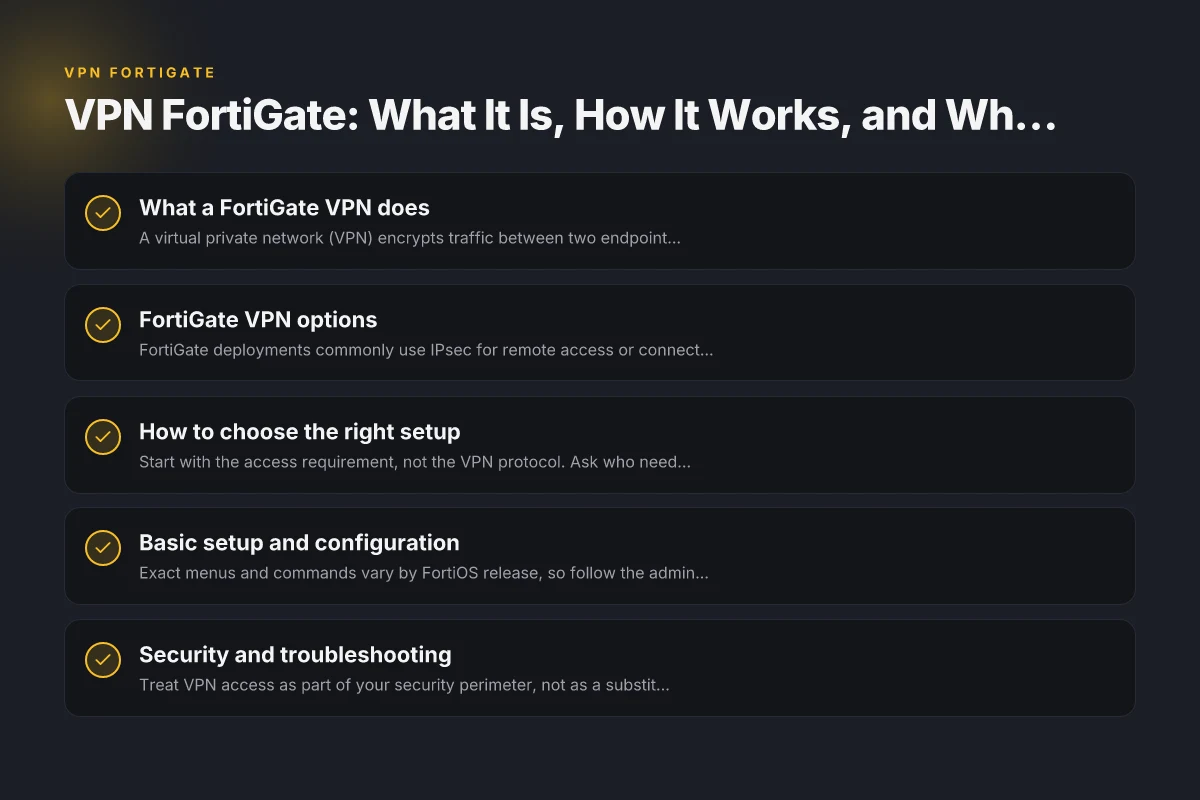
FortiGate deployments commonly use IPsec for remote access or connections between networks. Some FortiOS versions and hardware models also support SSL VPN, but availability and recommended configurations vary. Check the documentation for your specific FortiGate model and FortiOS release before choosing a design. Com.NordVPN.Android: What the NordVPN Android App Does and How to Use It
| Option | Common use | Key considerations |
|---|---|---|
| IPsec VPN | Remote access or site-to-site connections | Strong, widely used encryption; client and network settings must match |
| SSL VPN | Remote access, where supported | Often suited to user access; features and availability depend on FortiOS and model |
| Site-to-site IPsec | Connecting offices or networks | Requires matching tunnel settings and carefully defined routes and policies |
Fortinet’s VPN client and management options can also change over time. Use current, vendor-supported software and configuration guidance rather than relying on old tutorials that may describe features or defaults no longer recommended.
Choose a FortiGate VPN setup
| Need | Suitable option | What it connects | Main setup focus | Best fit |
|---|---|---|---|---|
| Link two office networks | IPsec site-to-site | Network to network | Matching tunnel and routing settings | Fixed locations |
| Give staff access from anywhere | Remote-access IPsec | User to network | Client, authentication, and access policies | Users needing broad network access |
| Provide browser-based access | SSL VPN web mode | Browser to selected resources | Portal and resource permissions | Limited web applications |
| Provide a network tunnel to users | SSL VPN tunnel mode | User device to network | Client settings and firewall policies | Supported deployments needing tunnel access |
| Use FortiClient for endpoint access | FortiClient VPN | Endpoint to FortiGate | Client compatibility and protocol choice | Managed or individual devices |
| Extend access through a cloud service | FortiSASE | Endpoint to cloud service | Service design and endpoint onboarding | Distributed users and cloud-first access |
Compiled November 2026; check the provider's site for current details.
How to choose the right setup
Start with the access requirement, not the VPN protocol. Ask who needs to connect, what they need to reach, and whether the connection is for individual devices or an entire network. Certificate Validation Failure Cisco VPN: Causes and Fixes
Choose remote access when staff need to connect from outside the office. Decide whether users need access to a small set of applications or broader network access. Restricting access to specific resources reduces the impact of a compromised account or device.
Choose site-to-site VPN when two trusted networks need ongoing communication. This approach is common for branch offices, partner networks, or cloud environments. Define which subnets should communicate and avoid routing all traffic through the tunnel unless there is a specific reason.
Also consider:
- FortiGate model, FortiOS version, and feature support
- Number of users and expected traffic
- User authentication and any multi-factor authentication requirements
- Whether users need a managed VPN client
- Network address overlap between locations
- Logging, monitoring, and incident-response needs
Basic setup and configuration
Exact menus and commands vary by FortiOS release, so follow the administration guide for your device. At a high level, a FortiGate VPN deployment involves these steps: FortiClientVPNOnlineInstaller: How to Download and Install FortiClient VPN
- Plan the networks and access. Record the local and remote subnets, users, applications, and expected traffic. Check for overlapping IP address ranges.
- Choose the VPN type. Select remote access or site-to-site, then choose a supported protocol and client approach.
- Configure authentication and encryption. Use strong, current cryptographic settings and unique credentials. For remote access, integrate multi-factor authentication where available and appropriate.
- Create the tunnel and network policies. Set the peer or client parameters, routes, and firewall rules. Permit only the traffic required for the intended use.
- Configure client devices or the remote gateway. Ensure that connection settings match on both ends. Distribute profiles securely and provide users with clear instructions.
- Test and monitor. Confirm that authorized traffic works, unauthorized traffic is blocked, and logs provide useful information for troubleshooting.
Avoid copying a configuration from another environment without reviewing it. Addressing plans, interfaces, FortiOS features, and security requirements can differ significantly.
Security and troubleshooting
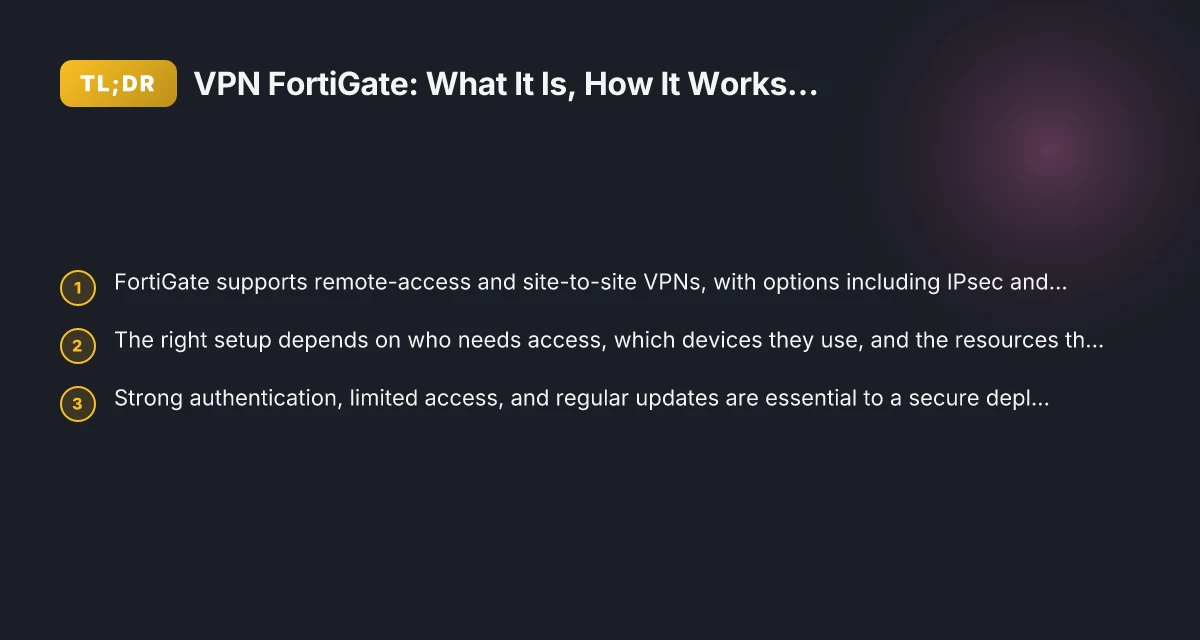
Treat VPN access as part of your security perimeter, not as a substitute for one. Apply least privilege: users and remote sites should receive only the access they need. Use unique accounts, strong authentication, and multi-factor authentication where supported. Keep FortiGate firmware and client software current, following Fortinet’s security advisories and maintenance recommendations.
Review logs for failed logins, unexpected connection patterns, and unusual traffic. Remove accounts and VPN profiles when they are no longer needed. For site-to-site tunnels, verify that both ends use compatible settings and that routes and firewall policies allow the intended traffic.
When a connection fails, check the basics first: Free VPN Extension for Microsoft Edge: What to Choose and How to Use It
- Confirm internet reachability and that the VPN service is available.
- Verify the username, authentication method, and client profile.
- Check that peer addresses, encryption settings, and shared parameters match.
- Review routing, firewall policies, and local device firewalls.
- Examine FortiGate logs and client error messages for specific clues.
Do not weaken encryption or open broad firewall access simply to make a tunnel connect. Identify the cause and correct the relevant setting instead.
Basic FortiGate VPN checks
| Check | What to verify | Common symptom if incorrect | Security implication | Next step |
|---|---|---|---|---|
| VPN type | Both ends use compatible options | Tunnel does not establish | Mismatched settings weaken reliability | Confirm the design at both ends |
| Authentication | User or peer credentials are valid | Login or tunnel authentication fails | Weak credentials raise access risk | Use strong credentials and suitable authentication |
| Encryption settings | Proposals match and use supported settings | Negotiation fails | Outdated settings can reduce protection | Select supported, current settings |
| Routing | Routes cover intended networks | Tunnel is up but resources are unreachable | Excessive routes expand access | Limit routes to required networks |
| Firewall policies | Rules permit required VPN traffic | Connection succeeds but traffic is blocked | Broad rules expose more services | Allow only necessary traffic |
| DNS | VPN clients receive appropriate DNS settings | Internal names do not resolve | Incorrect DNS can send queries elsewhere | Check assigned DNS servers and search domains |
| FortiOS and client versions | Versions support the chosen VPN option | Client cannot connect or features are missing | Unsupported versions may lack fixes | Check compatibility and apply updates |
| Logs and diagnostics | Events show negotiation and policy results | Cause remains unclear | Logs may contain sensitive details | Review securely and redact before sharing |
Compiled November 2026; check the provider's site for current details.
Recommendation
For a small or mid-sized organization, choose the supported FortiGate VPN option that fits the use case, then keep access narrow and authentication strong. Use remote access for individual users and site-to-site IPsec for network-to-network connectivity. Before deployment, confirm compatibility with your FortiGate model and FortiOS version, test the configuration, and establish a routine for updates, log review, and access audits. NordVPN in China: What to Know Before You Travel