IPsec over TCP 443: What It Is and When to Use It
Learn how IPsec over TCP 443 works, its trade-offs, and when to choose it over standard IPsec or another VPN protocol.
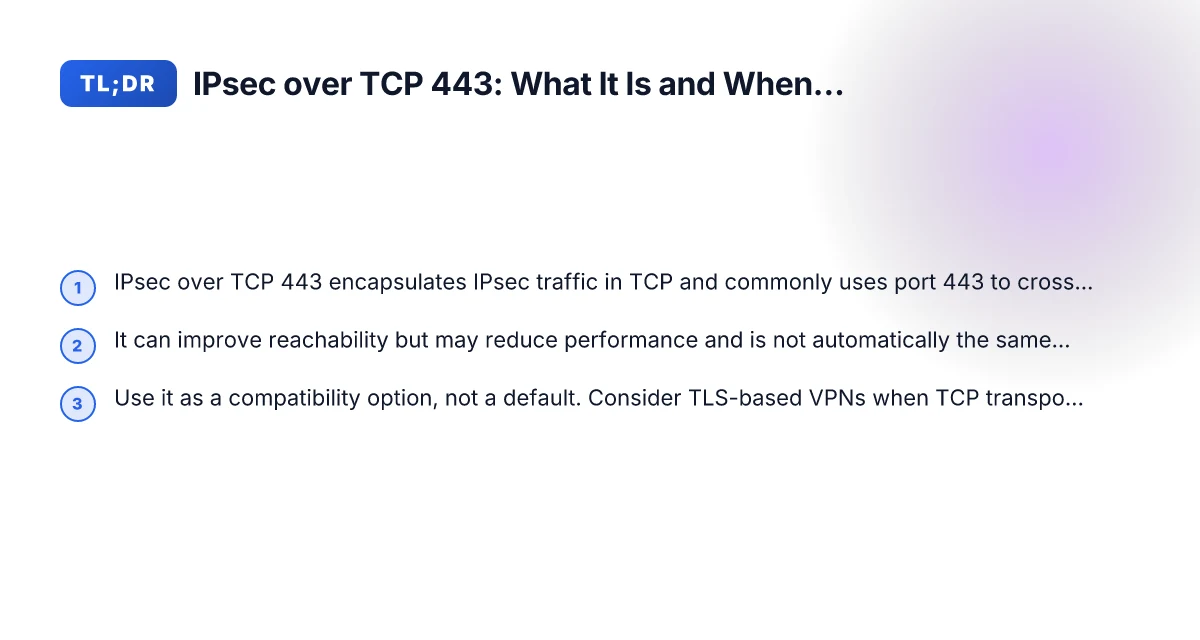
IPsec over TCP 443 is a way to carry IPsec VPN traffic inside a TCP connection that uses port 443, the port commonly associated with HTTPS. It can help a VPN connect from networks that block or restrict standard IPsec traffic, but it does not make IPsec identical to web browsing, guarantee that the connection will pass through every firewall, or eliminate performance trade-offs. Whether it works depends on the VPN implementation and the network in between.

Editor's pick: NordVPN — fast, secure VPN — Strong encryption, a no-logs policy and apps for every device. 30-day money-back guarantee. Get NordVPN →
How IPsec over TCP 443 compares with common VPN transport options
| Option | Transport | Port | Network compatibility | Main advantage | Main trade-off |
|---|---|---|---|---|---|
| IPsec over TCP 443 | IPsec encapsulated in TCP | 443 | Often passes through restrictive networks | Uses a commonly allowed port | TCP-over-TCP performance issues |
| Native IPsec | ESP, with optional IKE over UDP | ESP; UDP 500/4500 | May be blocked by firewalls or NAT | Avoids TCP-over-TCP | Requires IPsec traffic to be allowed |
| IPsec NAT traversal | ESP encapsulated in UDP | UDP 4500 | Works through many NAT devices | Maintains IPsec without TCP | UDP may be blocked |
| OpenVPN over TCP | OpenVPN over TCP | Often 443 | Often passes through restrictive networks | Flexible and widely supported | TCP-over-TCP performance issues |
| OpenVPN over UDP | OpenVPN over UDP | Configurable | Requires UDP access | Often performs well | UDP may be blocked |
| WireGuard | WireGuard over UDP | Configurable | Requires UDP access | Lightweight transport | TCP-only networks can block it |
Compiled November 2026; check the provider's site for current details.
What IPsec over TCP 443 means
Traditional IPsec VPNs commonly use the Internet Key Exchange (IKE) protocol to negotiate a secure connection, along with IPsec traffic carried using Encapsulating Security Payload (ESP). IKE typically uses UDP ports 500 and 4500; ESP itself is an IP protocol rather than a TCP or UDP port.
Some networks block these protocols or allow only a narrow set of outbound connections. To address this, certain VPN products can wrap or tunnel IPsec traffic over TCP. They may use TCP port 443, which many networks allow for outbound web connections.
The details vary by vendor. “IPsec over TCP” is not one universally interchangeable transport that every IPsec client supports. A client and VPN gateway generally need compatible features and configuration.
Why use TCP port 443?
The main reason is connectivity. Hotels, guest Wi-Fi, corporate networks, and other managed environments may restrict UDP traffic or block common VPN protocols. A TCP connection on port 443 may be permitted where standard IPsec cannot connect. VPN That Allows You to Choose Location for Free: What to Know
Possible benefits include:
- Better chances of connecting on networks with strict outbound rules.
- An alternative when UDP-based IPsec or NAT traversal fails.
- Continued use of an organization’s existing IPsec VPN infrastructure, if its gateway supports the feature.
However, port 443 is not a pass that defeats all network controls. Firewalls can inspect traffic, enforce proxy requirements, or allow only connections that behave like approved HTTPS sessions. A network administrator may block or limit VPN traffic even when it uses port 443. Always follow the network’s rules and your organization’s security policy.
Performance and security trade-offs
Wrapping traffic that would normally use IPsec’s more direct transport in TCP can add overhead. One particular concern is TCP-over-TCP behavior: the outer TCP connection may retransmit packets while the inner traffic also responds to loss. Under congestion or packet loss, this can lead to delays, reduced throughput, or uneven performance.
The impact depends on the implementation, network conditions, and the applications being used. TCP transport is not always slower, but it is a practical trade-off rather than a free improvement. For latency-sensitive calls, interactive tools, or large transfers, test the connection under realistic conditions. Free Location Changer VPN: What It Can, and Cannot, Do
Using port 443 does not, by itself, provide encryption or prove a connection is secure. Security comes from the VPN’s cryptographic design and configuration, including strong authentication, up-to-date software, and correctly validated certificates or keys. A TCP wrapper is a transport choice, not a substitute for those controls.
| Option | Typical transport | Potential advantage | Common limitation |
|---|---|---|---|
| Standard IPsec | IKE and ESP, often with UDP-based NAT traversal | Efficient and widely used for site-to-site and remote-access VPNs | May be blocked by restrictive networks |
| IPsec over TCP 443 | IPsec carried over TCP, often on port 443 | May connect where UDP VPN traffic is restricted | Requires compatible support and can perform poorly on lossy links |
| TLS-based VPN | TLS over TCP, often on port 443 | Designed to use TLS transport and may fit some proxy or firewall environments better | Still subject to network policy and product-specific limitations |
These categories are not identical across vendors. Check the VPN product documentation before comparing modes or changing a gateway’s settings.
Performance and security trade-offs
| Consideration | IPsec over TCP 443 | Native IPsec or UDP transport | What to check |
|---|---|---|---|
| Firewall traversal | Often easier on restricted networks | May require firewall changes | Confirm outbound traffic is allowed |
| TCP-over-TCP | Can cause retransmissions and delays | Avoided when using UDP | Test under packet loss |
| Throughput | May be lower on congested links | Often better for real-time traffic | Compare sustained transfer rates |
| Latency | Can increase during loss or congestion | Often lower with UDP | Test interactive applications |
| Encryption | Depends on the IPsec configuration | Depends on the IPsec configuration | Verify algorithms and policy |
| Authentication | Depends on the IPsec configuration | Depends on the IPsec configuration | Check peer identity and credentials |
| Port sharing | TCP 443 may already serve HTTPS | Usually uses separate ports or protocols | Check for port conflicts |
| Visibility | May resemble ordinary TCP traffic | UDP or ESP may be easier to identify | Do not treat port choice as encryption |
Compiled November 2026; check the provider's site for current details. Best Free VPN That Lets You Pick Locations: What to Choose
Configuration and troubleshooting
Do not assume that changing a port number in a client is enough. The VPN gateway must support the chosen transport, and the client must use the matching mode. In an organization, ask the VPN administrator which connection profile to use rather than changing security settings independently.
If the connection fails, check:
- Gateway support: Confirm that IPsec over TCP is enabled and supported on both ends.
- Client settings: Use the provider’s documented profile and the correct server address and port.
- Network restrictions: A captive portal, explicit web proxy, or outbound policy may prevent the connection.
- Logs and error messages: Client and gateway logs can help distinguish a blocked connection from failed authentication or incompatible settings.
- Updates and time: Keep VPN software current and ensure the device clock is accurate, since both can affect negotiation and certificate checks.
Test standard IPsec and TCP mode from the same network when permitted. If TCP mode connects but is noticeably slower, that may reflect the transport and the network rather than a faulty encryption setup. Avoid disabling certificate validation, weakening authentication, or using an unapproved gateway as a workaround.
When to choose it
IPsec over TCP 443 is most useful as a fallback when a required IPsec VPN cannot connect over its normal transport and the VPN gateway explicitly supports TCP mode. It can be a practical option for remote users who regularly encounter restrictive networks. FortiClient VPN 7.4.3 Download: Safe Sources and Installation Guide
It is usually not the first choice when standard IPsec works reliably, especially if performance and low latency matter. If a network requires a web proxy or tightly validates HTTPS traffic, a VPN designed for TLS transport may be a better fit, but only if it is approved and supported by the organization.
Choosing and troubleshooting an IPsec transport
| Situation or symptom | Option or check | Likely benefit | Limitation |
|---|---|---|---|
| UDP and ESP are blocked | Try IPsec over TCP 443 | May establish a tunnel through restrictive networks | Requires compatible client and gateway |
| UDP is available | Prefer native IPsec or UDP transport | Avoids TCP-over-TCP behavior | Firewall must permit the traffic |
| Connection fails to start | Check client and gateway support | Confirms both ends can use the same mode | Configuration may differ by vendor |
| TCP 443 is already occupied | Check gateway listener and service binding | Prevents port conflicts | May require a different endpoint |
| Tunnel connects but is slow | Compare with UDP transport | Helps identify TCP-over-TCP effects | Network congestion can still limit speed |
| NAT traversal is needed | Verify NAT-T support and UDP 4500 access | Enables IPsec through many NAT devices | Does not help if UDP is blocked |
| Traffic is still blocked | Review firewall rules and logs | Identifies filtering or routing issues | Port 443 alone does not guarantee passage |
| Choosing for routine use | Use TCP 443 as a fallback when needed | Preserves access on restrictive networks | Prefer UDP when performance is the priority |
Compiled November 2026; check the provider's site for current details.
Recommendation
Use IPsec over TCP 443 only when your VPN provider or administrator supports it and standard IPsec is blocked or unreliable. Confirm that the network permits the connection, test performance, and keep authentication and encryption settings strong. For everyday use, prefer the VPN’s recommended transport. Treat TCP 443 as a compatibility option, not a guarantee of access or better speed. VPN for Microsoft Edge Extension: How to Choose and Use One