What Is a Proxy Server? How It Works, Types, and When to Use One
Learn what a proxy server does, how it routes internet traffic, and how to choose the right type for privacy, security, or access.
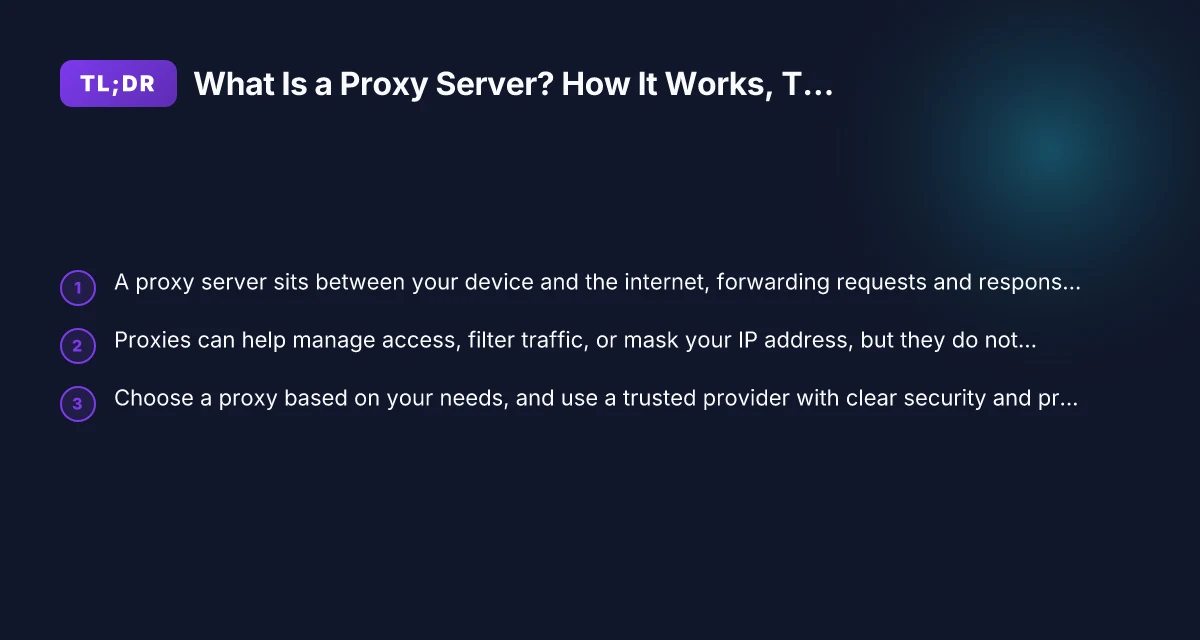
A proxy server is an intermediary between your device and the websites or other online services you use. Instead of connecting directly, your device sends a request to the proxy, which forwards it to the destination and returns the response. Depending on its setup, a proxy can help manage internet access, filter content, cache information, or make a connection appear to come from a different IP address.
A proxy is not automatically a security or anonymity solution. What it can see, protect, or conceal depends on the type of proxy, how it is configured, and whether the connection is encrypted.

Editor's pick: NordVPN — fast, secure VPN — Strong encryption, a no-logs policy and apps for every device. 30-day money-back guarantee. Get NordVPN →
Compare common proxy types by how they work and when they fit
| Proxy type | What it does | Common use | Main consideration |
|---|---|---|---|
| Forward proxy | Routes a user’s requests to the internet | Access control or filtering | Usually configured on the user’s device or network |
| Transparent proxy | Intercepts requests without requiring manual setup | Network monitoring or filtering | Users may not know it is in use |
| Anonymous proxy | Hides the user’s IP address from destination sites | General privacy | Does not necessarily hide proxy use |
| High-anonymity proxy | Hides the user’s IP and proxy use | More discreet browsing | Trust in the provider still matters |
| Residential proxy | Uses an IP address associated with a residential connection | Location-based access or data collection | Can be slower or more costly |
| Datacenter proxy | Uses an IP address from a data center | Speed or large-scale requests | Sites may identify and block it |
| Reverse proxy | Sits in front of servers and handles incoming requests | Security, load balancing, or caching | Requires server-side configuration |
| SOCKS proxy | Relays varied network traffic | Apps that support SOCKS | Does not encrypt traffic by itself |
| HTTP proxy | Handles web traffic using HTTP or HTTPS | Browser or web requests | Generally limited to web traffic |
Compiled November 2026; check the provider's site for current details.
How a proxy server works
When you visit a website without a proxy, your device typically sends a request to the site’s server. The site can receive information such as your public IP address, which may indicate your network or approximate location.
With a proxy, the request takes an extra step:
- Your device sends the request to the proxy server.
- The proxy forwards it to the website or service.
- The destination sends its response back to the proxy.
- The proxy passes the response to your device.
The website generally sees the proxy’s IP address as the source of the request, rather than your device’s public IP address. However, a proxy may identify itself to the destination or pass along your original IP address, depending on its configuration.
A proxy can also apply rules along the way. For example, a workplace proxy might block certain sites, record requests for security monitoring, or serve a cached copy of frequently requested content. Edge VPN: What It Is and Which Option Should You Choose?
What proxy servers are used for
Organizations and individuals use proxies for different reasons. Common uses include:
- Managing access: Schools and businesses can restrict access to certain websites or services.
- Filtering traffic: A proxy can enforce content rules, scan requests, or block known threats.
- Improving performance: Caching proxies store copies of frequently requested resources to reduce loading times and bandwidth use.
- Controlling network use: Administrators can monitor traffic and apply policies to users or devices.
- Changing the apparent IP address: A proxy may make a website see the proxy’s IP address instead of the user’s, depending on the proxy type and setup.
- Connecting through a company network: Some organizations require employees to use a proxy to reach external websites.
Proxies can also be used to access services that are restricted by location or network policy. Whether that is permitted depends on the service’s terms and the rules that apply where you are.
Common types of proxy servers
Proxy types differ in what traffic they handle and how they are used.
- Forward proxy: Sits between clients and the internet. It is commonly used by organizations to control or monitor outgoing web traffic.
- Reverse proxy: Sits in front of one or more web servers. It receives requests from visitors and routes them to the appropriate server. Websites often use reverse proxies for load balancing, performance, and protection.
- Transparent proxy: Handles traffic without requiring users to configure it in the usual way. It may not hide the user’s IP address from the destination.
- Anonymous proxy: Attempts to conceal the user’s IP address, though it may still reveal that a proxy is being used.
- High-anonymity proxy: Is configured to avoid identifying itself as a proxy and to avoid forwarding the user’s IP address. The level of privacy still depends on the provider and setup.
- SOCKS proxy: Can relay different kinds of network traffic, not just web pages. It does not inherently encrypt traffic.
- HTTP or HTTPS proxy: Handles web traffic. HTTPS describes encrypted communication between the browser and website. It does not by itself guarantee that the proxy operator cannot see connection details or metadata.
The labels used by providers are not always consistent, so check what a service actually supports and records. VPN Edge: How to Choose the Right Protection for Microsoft Edge
Proxy vs. VPN for common privacy and access needs
| Comparison | Proxy | VPN |
|---|---|---|
| Routes traffic through an intermediary | Yes | Yes |
| Can change the IP address seen by a site | Yes | Yes |
| Encrypts traffic by default | No | Yes |
| Often applies to selected apps or traffic | Yes | Usually covers device traffic |
| Can help access location-restricted content | Sometimes | Sometimes |
| Hides the user’s IP from destination sites | Yes | Yes |
| Protects traffic on public Wi-Fi | Not by itself | Yes, when properly configured |
| Provider can be a point of trust | Yes | Yes |
| Best fit | Targeted routing or filtering | Broader traffic protection |
Compiled November 2026; check the provider's site for current details.
Proxy vs. VPN
A proxy and a virtual private network (VPN) can both route traffic through another server, but they are not the same. A proxy often handles a particular application or type of traffic. A VPN typically creates an encrypted connection for traffic from the device or selected apps, depending on its configuration.
| Feature | Proxy server | VPN |
|---|---|---|
| Typical coverage | Often one app or traffic type | Often the whole device or selected apps |
| Encrypts the connection | Not necessarily | Usually encrypts the tunnel between your device and the VPN server |
| Can change the apparent IP | Often, depending on setup | Usually |
| Common uses | Filtering, caching, access control, routing | Protecting traffic on untrusted networks, private network access, routing |
| Trust still matters | Yes | Yes |
Neither option makes you completely anonymous. A VPN provider can still see certain connection information, and a proxy operator may be able to observe or record traffic. HTTPS protects the content exchanged between your browser and an HTTPS website from many intermediaries, but it does not hide every detail, such as the fact that you connected to a particular domain. Free VPN Extension for Microsoft Edge: What to Choose and How to Use It
Benefits, limitations, and risks
A properly configured proxy can help an organization apply consistent web policies, reduce repeated downloads, or route requests through its network. For individuals, a proxy may be useful when a specific application needs a different route to the internet.
But proxies have important limitations:
- A proxy may not encrypt traffic. Without encryption, information sent over an unprotected connection could be exposed to parties on the network.
- The operator may see activity. Depending on the proxy and the sites you visit, the operator may be able to see connection details or unencrypted data.
- Your IP may not be fully concealed. Some proxies pass the original IP address or reveal that a proxy is in use.
- Free services can carry risks. Some may collect browsing data, inject ads, use weak security, or provide unreliable connections.
- A proxy does not protect everything. It does not automatically stop malware, phishing, tracking cookies, or account-based identification.
For sensitive activities, do not assume that a proxy alone provides adequate protection. Check whether traffic is encrypted, review the provider’s logging and privacy policies, and follow your organization’s security guidance if you are using a work or school network.
Choose a proxy approach based on your goal and trade-offs Cisco VPN: What It Is, How to Set It Up, and When to Use It
| Goal | Proxy approach | Potential benefit | Limitation or risk | Check before use |
|---|---|---|---|---|
| Filter workplace web access | Forward proxy | Centralized access rules | May limit user privacy | Review monitoring policies |
| Monitor or filter a network | Transparent proxy | No manual device setup | Users may not realize traffic is intercepted | Confirm notice and authorization |
| Hide your IP for web requests | Anonymous proxy | Destination sees the proxy IP | Traffic may remain unencrypted | Check HTTPS support |
| Reduce disclosure of proxy use | High-anonymity proxy | Conceals proxy use from destinations | Does not remove provider trust concerns | Review provider practices |
| Access content tied to a location | Residential proxy | Uses a residential-associated IP | Cost and speed can vary | Check permitted use and location coverage |
| Make many web requests | Datacenter proxy | Can support fast, large-scale requests | IPs may be blocked | Check site rules and rate limits |
| Protect and manage a website’s servers | Reverse proxy | Can add caching or load balancing | Needs server configuration | Confirm security and maintenance needs |
| Route app traffic beyond web browsing | SOCKS proxy | Supports varied traffic types | Does not encrypt traffic by itself | Pair with encryption when needed |
| Protect traffic across a device | VPN instead of proxy | Encrypts device traffic | Requires trusting the VPN provider | Review logging and privacy policies |
Compiled November 2026; check the provider's site for current details.
How to choose and use a proxy
Start with the problem you want to solve. An organization that needs to filter employee traffic has different requirements from a website that needs to distribute visitor requests across several servers.
Before choosing a service, consider:
- Which applications and traffic types it supports
- Whether the connection is encrypted and how encryption is handled
- What information the provider logs and how long it keeps records
- The provider’s reputation, security practices, and support
- Whether the setup is allowed by the relevant service and network policies
- Whether the proxy’s speed and reliability suit your needs
Avoid entering passwords or payment details through a proxy you do not trust. For HTTPS sites, confirm that the browser shows a secure connection and that there are no certificate warnings. On a managed network, ask the administrator what traffic is monitored and why. GlobalProtect VPN Not Connecting? Causes and Fixes
Recommendation
A proxy server is best understood as a traffic intermediary, not a guarantee of privacy. Use one when you need a specific function such as access control, caching, or routing, and choose a reputable service that clearly explains its security and logging practices. If your goal is broader protection for device traffic, compare a properly configured VPN and other security measures rather than relying on a proxy alone.