Is Cato a VPN? How Cato SASE and Cato Client Work
Cato includes VPN-like remote access, but it is a broader cloud-based SASE security platform.
If you’re asking “is Cato a VPN?”, the short answer is: Cato provides VPN-like secure access, but it is more than a traditional VPN. Cato Networks offers a cloud-based Secure Access Service Edge (SASE) platform that combines network connectivity and security. Its Cato Client can connect remote employees to company resources, while the wider platform can also apply security controls to that traffic.

Editor's pick: NordVPN — fast, secure VPN — Strong encryption, a no-logs policy and apps for every device. 30-day money-back guarantee. Get NordVPN →
Cato SASE vs. a traditional VPN
| Comparison point | Cato SASE | Traditional VPN |
|---|---|---|
| Main purpose | Connects users, sites, and cloud resources | Creates a private network connection |
| Network approach | Cloud-based SASE platform | VPN gateways or concentrators |
| User access | Cato Client or site connectivity | VPN client or site-to-site tunnel |
| Security scope | Networking and security services | Primarily encrypted connectivity |
| Traffic routing | Through Cato’s global network | Through configured VPN gateways |
| Policy management | Centralized in the Cato platform | Depends on VPN products and setup |
| Best fit | Organizations seeking integrated SASE | Organizations needing VPN connectivity |
| Consumer privacy use | Not primarily a consumer VPN | Depends on the VPN service |
Compiled November 2026; check the provider's site for current details.
| VPN | Obfuscation | From / month | Plan | Free plan | Refund | Alipay | UnionPay | Crypto | Website opens in China | Trustpilot | |
|---|---|---|---|---|---|---|---|---|---|---|---|
 ZoogVPN | Turn on manually Shadow | $2.49/mo | 27 months: $59.99 | Yes | 7 days | ✓ | ✓ | ✓ | ✓ | Official site blocked; our special link opens (4.4 s) | 4.2/5 (195 reviews) |
 NordVPN | Turn on manually Obfuscated Servers / NordWhisper | $3.49/mo | 27 months: $94.23 | No | 30 days | ? | ✗ | ✓ | ✓ | ✗ Blocked | 4.2/5 (51,628 reviews) |
 ExpressVPN | ✓ On by default all servers | $3.00/mo | 28 months: $84 | No | 30 days | ✗ | ✗ | ✓ | ✗ | ✗ Blocked | 4.4/5 (29,706 reviews) |
 Surfshark | ✓ On by default Camouflage, with OpenVPN | See site | See site | No | 30 days | ✗ | ✗ | ✗ | ✓ | ✗ Blocked | 4.3/5 (31,823 reviews) |
 Proton VPN | Turn on manually Stealth, free plan too | $2.99/mo | 12 months: $35.88 | Yes | 30 days | ✗ | ✗ | ✗ | ✓ | ✗ Blocked | 2.1/5 (1,040 reviews) |
 Astrill VPN | Turn on manually StealthVPN / OpenWeb | $12.50/mo | 24 months: $300 | No | See site | ✗ | ✗ | ✗ | ✓ | ✗ Blocked | 1.3/5 (110 reviews) |
 Private Internet Access | Turn on manually Shadowsocks, OpenVPN only | $2.03/mo | 40 months: $81.2 | No | 30 days | ✗ | ✗ | ✗ | ✗ | ✗ Blocked | 4.2/5 (11,033 reviews) |
 CyberGhost | Turn on manually selected servers | $2.19/mo | 28 months: $61.32 | No | 45 days | ✗ | ✗ | ✗ | ✓ | ✗ Blocked | 4.0/5 (24,178 reviews) |
 PureVPN | Turn on manually switch to OpenVPN | $1.69/mo | 60 months: $101.55 | No | 31 days | ? | ? | ✗ | ✓ | ✗ Blocked | 4.4/5 (17,994 reviews) |
 AdGuard VPN | ✓ On by default TrustTunnel | $2.99/mo | 24 months: $71.76 | Yes | 30 days | ✓ | ✗ | ✓ | ✓ | Official site blocked; our special link opens (3.7 s) | 4.3/5 (290 reviews) |
 Mullvad | Turn on manually QUIC / Shadowsocks / LWO | $5.61/mo | €5/mo | No | 14 days | ✗ | ✗ | ✗ | ✓ | ✗ Blocked | 3.2/5 (192 reviews) |
 Windscribe | Turn on manually Stealth / WStunnel | $5.75/mo | 12 months: $69 | Yes | See site | ✗ | ✗ | ✗ | ✓ | ✗ Blocked | 4.7/5 (13,355 reviews) |
 StrongVPN | Turn on manually Scramble, OpenVPN TCP | See site | See site | No | 30 days | ✓ | ✗ | ✗ | ✗ | ✗ Blocked | 4.4/5 (2,695 reviews) |
 LightXtreme 闪连 | Not listed | $7.08/mo | 12 months: $84.99 | Yes | 30 days | ✓ | ✓ | ✓ | ✓ | ✓ Yes (3.5 s) | No page |
Prices checked 2026-11-10 on each vendor's pricing page (cheapest long plan, USD). Check the vendor's checkout for the final price.
Obfuscation checked 2026-11-14 on each vendor's site and help center: "on by default" = nothing to set; "turn on manually" = switch protocol or mode in settings; "not listed" = the vendor describes no obfuscation.
Payment methods checked 2026-11-10 on each vendor's payment pages: all 14 take cards and PayPal; ✗ = not listed, ? = the vendor's own pages disagree.
China access: whether the official website opens from mainland China networks (tests the website only, not the VPN connection). Last checked 2026-11-18 01:02 Beijing time.
Trustpilot score and review count checked 2026-11-10.
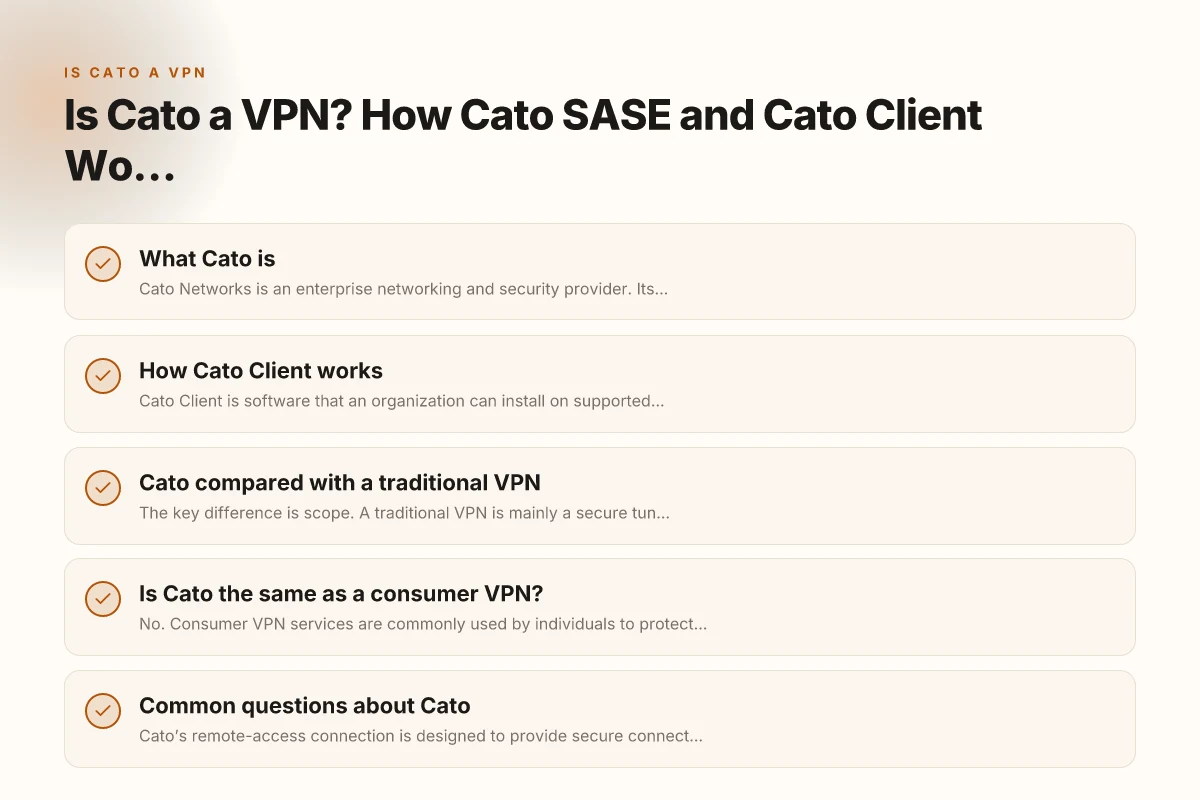
What Cato is
Cato Networks is an enterprise networking and security provider. Its SASE platform connects an organization’s offices, remote workers, cloud services, and data centers through a global cloud network.
A conventional VPN typically creates an encrypted connection between a user’s device and a company network, or between two networks. Cato can provide this kind of secure remote access, but its platform brings additional networking and security capabilities together.
Depending on how an organization deploys it, Cato may support:
- Secure access for remote employees
- Connections between offices and cloud environments
- Traffic routing across Cato’s global network
- Security inspection and policy enforcement
- Central management of users, locations, and network traffic
That broader scope is why Cato is generally described as a SASE platform rather than just a VPN. How to Enable VPN in Edge: Turn On Microsoft Edge Secure Network
How Cato Client works
Cato Client is software that an organization can install on supported employee devices. When configured for remote access, it connects the device to the organization’s Cato environment. The connection can help protect traffic and provide access to approved company resources.
The exact experience depends on the company’s setup. An administrator may require the client to connect before certain internal applications are available, or may configure access rules based on a user, device, location, or other conditions.
Cato Client is not automatically a consumer privacy tool. It is usually provided and managed by an employer or another organization. The organization’s administrators determine how it is used, which services it connects to, and what security policies apply.
Which option fits your use case? Free Clash: How to Play Clash Games for Free and Avoid Costly Mistakes
| Use case | Cato Client | Traditional business VPN | Consumer VPN |
|---|---|---|---|
| Employee access to company resources | Supported | Supported | Not designed for this |
| Connecting office locations | Supported through Cato | Supported by site-to-site VPN | Not designed for this |
| Centralized enterprise security | Supported through Cato SASE | Depends on the solution | Not designed for this |
| Routing traffic through a privacy service | Not its primary purpose | Not its primary purpose | Common use |
| Organization-wide access policies | Managed through Cato | Depends on the product | Usually not designed for this |
| Individual browsing on public Wi-Fi | Not its primary purpose | Possible with a company VPN | Common use |
| Company-managed devices | Supported | Supported | Usually not designed for this |
Compiled November 2026; check the provider's site for current details.
Cato compared with a traditional VPN
The key difference is scope. A traditional VPN is mainly a secure tunnel. Cato combines remote connectivity with other networking and security functions in a cloud-delivered platform.
| Feature | Traditional VPN | Cato SASE platform |
|---|---|---|
| Main purpose | Create a secure connection to a network | Connect users and locations while applying network and security services |
| Remote employee access | Common | Available through Cato Client and organizational policies |
| Network coverage | Often focused on a company network or VPN gateway | Can connect users, offices, cloud environments, and data centers |
| Security features | Varies by VPN product and configuration | May combine access control, traffic inspection, and other security services |
| Management | Often managed through VPN infrastructure | Centrally managed through the Cato platform |
| Typical audience | Individuals or organizations, depending on the product | Primarily organizations |
Features vary by product, subscription, and deployment. A Cato setup may not include every capability shown in the table, and a modern VPN product may also offer advanced security features.
Is Cato the same as a consumer VPN?
No. Consumer VPN services are commonly used by individuals to protect traffic on public Wi-Fi or to route connections through a provider’s servers. Some people also use them to change the apparent location of their internet connection. Proton VPN Extension for Edge: How to Install and Use It
Cato is generally an organization-managed business platform. If your employer asks you to use Cato Client, the purpose is typically to provide secure access to work systems and enforce company network policies, not to offer a personal VPN subscription.
Before using it, check your organization’s instructions. In particular, confirm:
- Whether you must connect to Cato to access work resources
- Whether the client routes all internet traffic or only selected traffic
- Which company policies apply to your device
- Whom to contact if the client will not connect
Avoid assuming that a work-managed Cato connection hides your activity from your employer. Visibility depends on the organization’s configuration and policies.
Cato Client decision checklist How to Fix Virgin TV Go App Not Working With VPN
| Question | If yes | If no |
|---|---|---|
| Do you need access to company resources? | Cato Client may fit | Consider another option |
| Does your organization use Cato SASE? | Ask your administrator about setup | Cato Client may not be applicable |
| Do you need a consumer privacy VPN? | Choose a consumer VPN service | Consider your business access needs |
| Do you need to connect multiple offices? | Evaluate Cato site connectivity | A user client may be sufficient |
| Do you need organization-managed security policies? | Evaluate Cato SASE | Compare simpler VPN options |
| Is your goal encrypted access to a private network? | Cato or a traditional VPN may fit | Identify the required use case first |
Compiled November 2026; check the provider's site for current details.
Common questions about Cato
Does Cato encrypt the connection?
Cato’s remote-access connection is designed to provide secure connectivity. The precise encryption and connection settings depend on the implementation and the client configuration. For technical or compliance details, consult your organization’s IT team or the relevant Cato documentation.
Can I use Cato without my employer?
Cato is typically deployed and managed by an organization. You generally need access to an organization’s Cato environment and the appropriate account or configuration. It is not usually a standalone consumer VPN service that someone simply subscribes to for personal browsing.
Will Cato change my IP address?
The public IP address that websites see can depend on how the organization routes internet traffic. Some configurations may send traffic through the Cato network, while others may route only work-related traffic through it. Your IT team can explain the setup used on your device. VPN Extension for Edge: How to Choose and Use One
Is Cato safe?
Cato is a business networking and security platform, but safety also depends on how it is configured and managed. Install the client only from a trusted source and follow your organization’s guidance. If you are unsure whether a download or login request is legitimate, verify it with your IT department.
Recommendation
Treat Cato as a business SASE platform with VPN-like remote access, not as a standard personal VPN. If your employer uses Cato, follow its setup and privacy guidance, and ask IT how your traffic is routed and what the client can access.