How to Change Proxy Settings in Edge: A Step-by-Step Guide

Learn how to configure, verify, and troubleshoot proxy settings for Microsoft Edge on Windows, Mac, and managed devices.
If you’re wondering how to change proxy settings in Edge, open Microsoft Edge, select Settings and more (the three-dot menu), then go to Settings > System and performance and select Open your computer’s proxy settings. Edge will open your device’s network settings, where you can configure a proxy server, automatic configuration script, or automatic detection. The exact steps vary by operating system, and your changes may affect other apps, not just Edge.

Editor's pick: NordVPN — fast, secure VPN — Strong encryption, a no-logs policy and apps for every device. 30-day money-back guarantee. Get NordVPN →
Compare proxy configuration options in Edge
| Option | How traffic is routed | Best for | Setup location | Main consideration |
|---|---|---|---|---|
| No proxy | Direct connection | Everyday browsing | Windows or Mac settings | Proxy is not used |
| Automatic detection | Uses detected network settings | Managed or configured networks | Windows proxy settings | Depends on network configuration |
| Setup script | Uses a configuration script | Networks with a supplied script | Windows proxy settings | Requires a valid script address |
| Manual proxy | Uses entered server details | A specific proxy server | Windows proxy settings | Requires server information |
| PAC file | Chooses a proxy using rules | Different routes for different sites | Proxy configuration | Requires a PAC file |
| VPN | Routes traffic through a VPN service | VPN-based connections | VPN app or system settings | Not the same as an Edge proxy |
| System proxy | Uses the operating system’s proxy settings | Keeping browser settings consistent | Windows or Mac settings | Edge follows system configuration |
Compiled November 2026; check the provider's site for current details.
Change proxy settings in Edge on Windows
Edge relies on Windows for most proxy configuration. To reach the relevant controls from the browser:
- Open Microsoft Edge.
- Select the three-dot menu in the upper-right corner.
- Select Settings.
- Choose System and performance.
- Select Open your computer’s proxy settings.
You can also open Windows proxy controls directly. In Windows 11, go to Settings > Network & internet > Proxy. In Windows 10, go to Settings > Network & Internet > Proxy.
Windows typically offers these options:
- Automatically detect settings: Lets Windows attempt to discover proxy settings for the network.
- Use setup script: Configures a proxy using a script address, often provided by an employer or school.
- Use a proxy server: Lets you enter a proxy address and port manually.
For a manual proxy, enable Use a proxy server, enter the server’s address and port, then save the changes. If Windows provides a box for exceptions, you can list addresses that should connect without the proxy. Follow the format shown in Settings, and ask your administrator if you are unsure what to enter. Why Does VPN Keep Turning On iPhone? Common Causes and Fixes
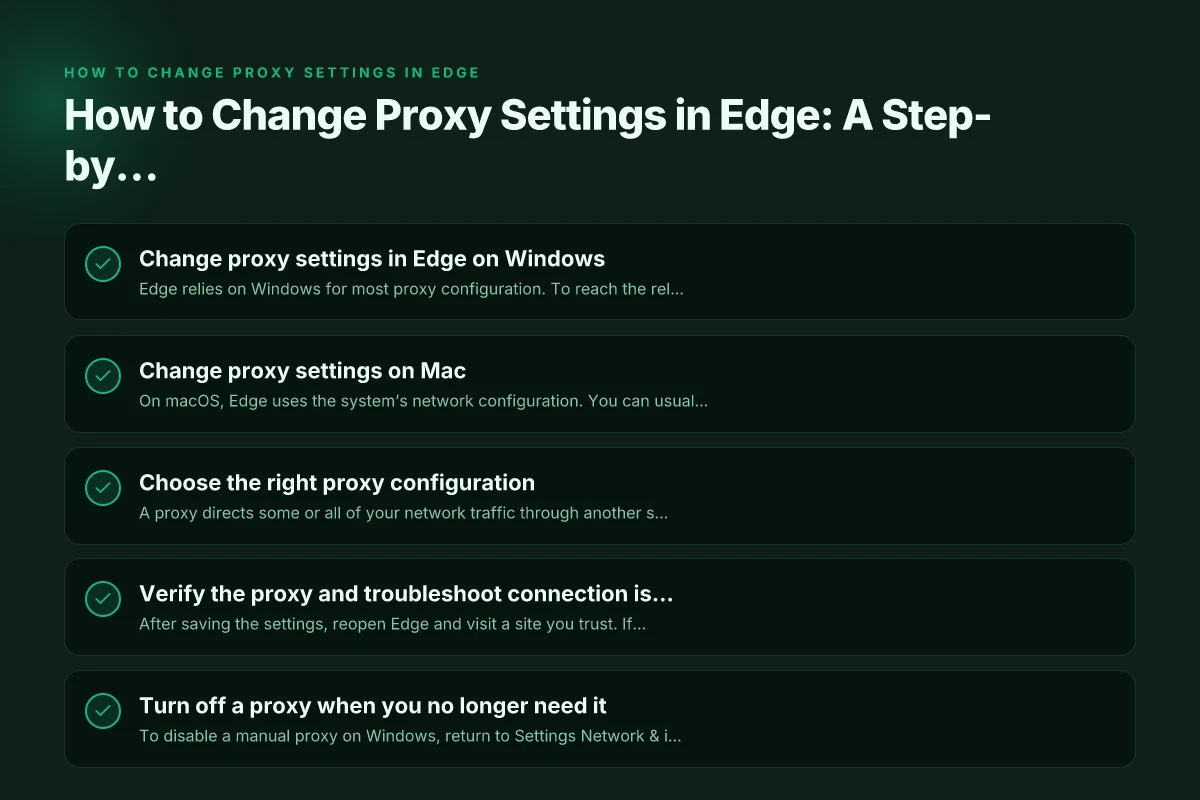
Change proxy settings on Mac
On macOS, Edge uses the system’s network configuration. You can usually open it from Edge by going to Settings > System and performance > Open your computer’s proxy settings. Alternatively, open System Settings, select Network, choose your active connection (such as Wi-Fi), and open its details. Look for Proxies in the network options.
Depending on your macOS version and network, you may see options such as:
- Auto proxy discovery
- Automatic proxy configuration
- Web proxy (HTTP)
- Secure web proxy (HTTPS)
- SOCKS proxy
Select only the proxy types and fields specified by your provider or network administrator. Enter the server address and port, then apply the changes. macOS menus can differ slightly between versions, so the names or locations may not match exactly.
Compare proxy settings on Windows and Mac My VPN Is Blocking Websites: Causes and Fixes
| Platform | Where to change settings | Configuration scope | Details to check | When to use |
|---|---|---|---|---|
| Windows | Windows proxy settings | System-level | Automatic detection, script, or manual proxy | To configure Edge through Windows |
| Mac | macOS network settings | System-level | Network service and proxy details | To configure Edge through macOS |
| Windows | Settings opened from Edge | Opens system proxy controls | Confirm the Windows proxy values | When starting in Edge |
| Mac | Settings opened from Edge | Opens system proxy controls | Confirm the macOS network service | When starting in Edge |
| Windows | Proxy script settings | System-level | Script address is correct | When an organization provides a script |
| Mac | Network proxy settings | System-level | Proxy type and server details | When a network supplies proxy details |
Compiled November 2026; check the provider's site for current details.
Choose the right proxy configuration
A proxy directs some or all of your network traffic through another server. The correct setup depends on the service or organization providing it.
| Setting | What you enter | Typical use |
|---|---|---|
| Automatic detection | Usually no manual address | A network that supplies proxy information automatically |
| Setup script | A script URL | A workplace or school that provides a proxy configuration file |
| Manual proxy | Server address and port | A provider or administrator gives you specific connection details |
Some proxies require a username and password. If a sign-in prompt appears, use credentials supplied by the proxy provider or your organization. Do not enter account details into an unfamiliar prompt, and do not assume a proxy encrypts your traffic. A proxy can change how connections are routed, but it is not a substitute for HTTPS or other security protections.
Verify the proxy and troubleshoot connection issues
After saving the settings, reopen Edge and visit a site you trust. If your organization or proxy provider offers a connection test, use that as well. Keep in mind that a proxy may apply only to certain destinations, depending on its configuration. Free VPN for Changing Location: What to Know Before You Connect
If websites stop loading, try these checks:
- Confirm the server address, port, and any script URL are correct.
- Check whether the proxy requires authentication.
- Make sure you are connected to the network the proxy was designed for.
- Review any bypass or exception list for incorrectly excluded sites.
- Turn off the proxy temporarily to see whether the connection works without it, if doing so is permitted.
- Restart Edge after changing settings. If necessary, disconnect and reconnect to the network.
If the setting is locked, keeps changing back, or displays a message that it is managed, your device may be controlled by a workplace or school. Contact its IT administrator rather than trying to override the policy. A VPN, security app, or other network tool may also manage proxy behavior.
Turn off a proxy when you no longer need it
To disable a manual proxy on Windows, return to Settings > Network & internet > Proxy and switch off Use a proxy server. If you enabled a setup script, turn off that option only if you are sure it is no longer required. On a Mac, return to the active network’s Proxies settings and deselect the proxy configuration you added.
Avoid changing settings you did not configure yourself, especially on a managed device. Disabling a required work or school proxy could prevent access to internal services or violate network policies. VPN Free Change Location: How to Switch Your IP Address Safely
Verify and troubleshoot a proxy connection
| Check | What to do | Expected result | If it fails | Next step |
|---|---|---|---|---|
| Proxy status | Review system proxy settings | Intended option is enabled | A different option is active | Select the intended configuration |
| Server address | Check the proxy host | Address matches supplied details | Address is missing or incorrect | Correct it with verified details |
| Port | Check the proxy port | Port matches supplied details | Port is missing or incorrect | Confirm the port with the provider |
| Script address | Review the setup script URL | Correct script is configured | URL is incorrect or unavailable | Verify the script address |
| Connection | Open a website in Edge | Page loads as expected | Connection fails | Recheck settings and network access |
| Direct connection | Turn off the proxy temporarily | Site works without the proxy | Site still fails | Check the general internet connection |
| Organization settings | Confirm whether settings are managed | Changes are permitted | Settings are controlled by an administrator | Contact the administrator |
| No longer needed | Disable the proxy setting | Traffic no longer uses that proxy | Connection remains affected | Review other system or network settings |
Compiled November 2026; check the provider's site for current details.
Recommendation
Use the proxy address, port, and configuration method supplied by a trusted provider or your network administrator. Change the setting through Edge’s system-settings link, verify that your connection works, and restore the original configuration when the proxy is no longer needed.